


2027 Toyota Camry Performance and Fuel Economy
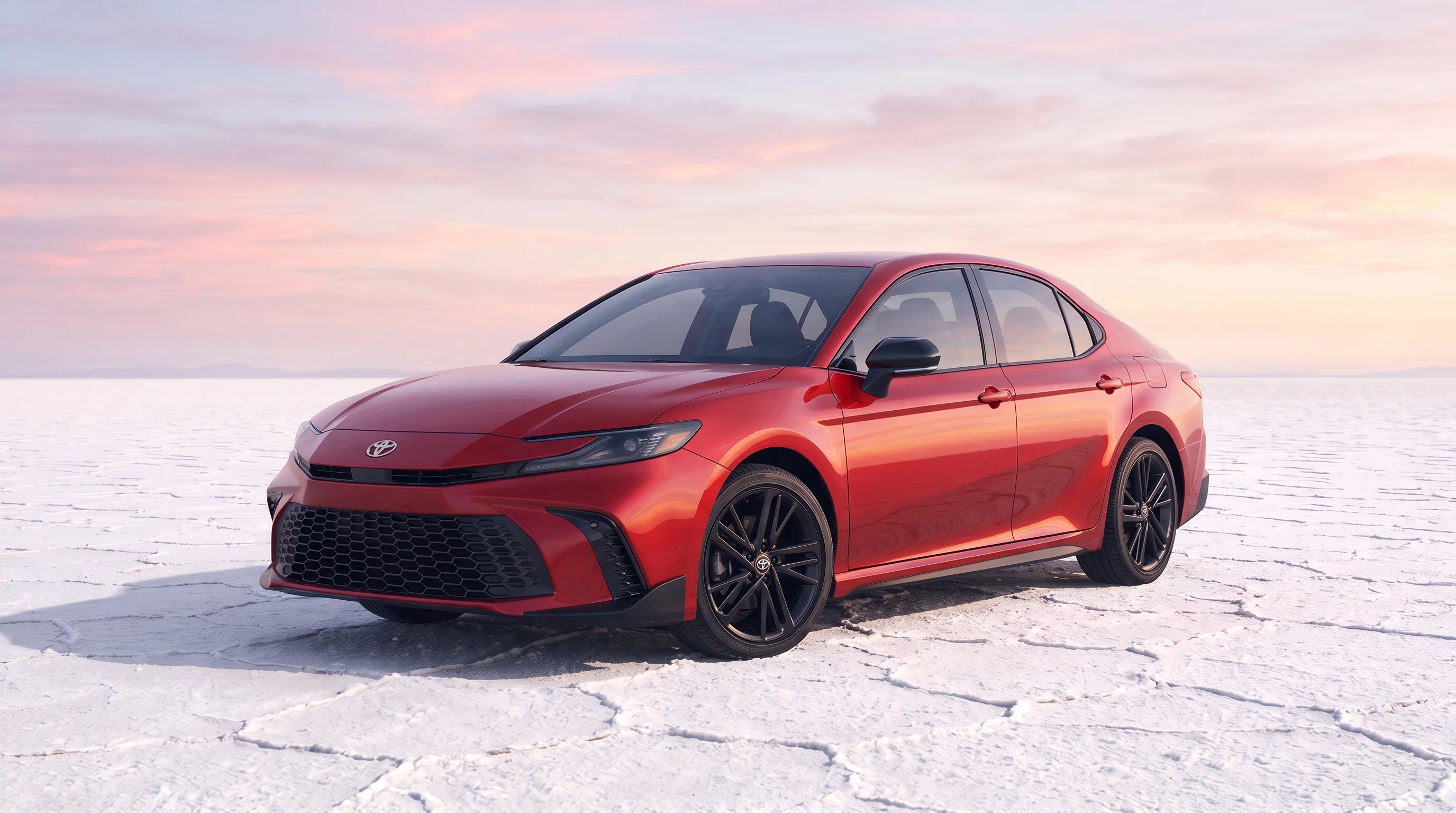
2027 Toyota Camry Engine and Horsepower
The 2027 Toyota Camry pairs a 2.5L four-cylinder engine with the fifth-generation Toyota Hybrid System (THS 5), producing 225 net-combined horsepower in front-wheel-drive models and 232 net-combined horsepower with Electronic On-Demand All-Wheel Drive. Every grade — LE, SE, Nightshade, XLE and XSE — uses this hybrid powertrain, which replaces the gas-only four-cylinder and V6 options of earlier Camry generations. Power routes through an electronically controlled continuously variable transmission (ECVT) that adjusts its ratio based on throttle input.
Toyota engineered this Camry around hybrid power from the start. The 2.5L DOHC 16-valve engine works with electric motor generators to deliver immediate low-end torque for quick response off the line. Front-wheel-drive models use two electric motors; all-wheel-drive models add a dedicated electric motor generator on the rear axle that drives the rear wheels whenever additional traction is needed.
Drivers commuting through the Saddleback Valley around Mission Viejo will notice how the hybrid system transitions between electric drive, gasoline power and combined output. Standard selectable NORMAL, ECO and SPORT drive modes let you sharpen throttle response for climbing local foothill grades or smooth power delivery for steady highway cruising. Toyota Safety Sense 3.0¶ is standard on every grade and works alongside the powertrain to assist with distance control and smooth deceleration.
¶ Driver-assist and safety systems are supplemental aids and are not a substitute for safe, attentive driving. Their effectiveness depends on weather, road, and traffic conditions and other factors. Always obey traffic laws and stay attentive to the road. See your owner’s manual for system details and limitations.
Cited Source: Toyota Newsroom — 2027 Camry grades, powertrain output, drive modes and standard safety equipment | Toyota.com 2027 Camry — horsepower and drivetrain availability | CarsDirect — motor configuration and torque rating
What Is the EPA-Estimated MPG for the 2027 Toyota Camry Across Trims?
The 2027 Toyota Camry LE with front-wheel drive leads the lineup at an EPA-estimated 52 mpg city, 49 mpg highway and 51 mpg combined‡. The SE, Nightshade, XLE and XSE with front-wheel drive each return an EPA-estimated 47 mpg city, 45 mpg highway and 46 mpg combined‡. All-wheel-drive models hold their efficiency closely, with the LE AWD rated at an EPA-estimated 50 mpg city, 49 mpg highway and 50 mpg combined‡.
EPA-Estimated Fuel Economy by Trim and Drivetrain
| 2027 Camry Trim | FWD (City / Hwy / Combined) | AWD (City / Hwy / Combined) | Combined MPG Change with AWD |
|---|---|---|---|
| LE | 52 / 49 / 51 mpg | 50 / 49 / 50 mpg | −1 mpg |
| SE | 47 / 45 / 46 mpg | 46 / 46 / 46 mpg | No change |
| Nightshade | 47 / 45 / 46 mpg | 46 / 46 / 46 mpg | No change |
| XLE | 47 / 45 / 46 mpg | 46 / 46 / 46 mpg | No change |
| XSE | 47 / 45 / 46 mpg | 43 / 43 / 43 mpg | −3 mpg |
‡ EPA-estimated fuel economy figures are for comparison purposes only. Your actual mileage will vary depending on driving conditions, how you drive and maintain your vehicle, battery age/condition, and other factors.
Why the LE Leads the Lineup
Shoppers comparing trims often ask why the LE rates higher than the sportier XSE. The difference comes down to wheel diameter, tire construction and curb weight — the LE is slightly lighter than the upper grades and rides on 16-inch alloy wheels, while the XSE uses 19-inch alloys with wider performance tires that add cornering grip at the cost of higher rolling resistance. The one real efficiency cliff in the lineup is the XSE AWD, which gives up three combined mpg to every other all-wheel-drive Camry.
For daily drives through the coastal foothills near Aliso Viejo, even that XSE AWD returns efficiency well beyond what conventional midsize sedans deliver. The Camry holds 13 gallons of regular 87-octane gasoline, and the EPA lists a total driving range of 663 miles‡ for the LE with front-wheel drive.
‡ EPA-estimated fuel economy figures are for comparison purposes only. Your actual mileage will vary depending on driving conditions, how you drive and maintain your vehicle, battery age/condition, and other factors.
You can browse our new Toyota Camry inventory to compare available trims and efficiency figures in person.
Cited Source: EPA Fuel Economy Guide — official city, highway and combined ratings for every Camry hybrid configuration | EPA — fueleconomy.gov — total driving range by configuration | Toyota.com 2027 Camry — LE combined rating and fuel capacity | Cars.com — wheel size and curb weight as efficiency factors
Does the 2027 Toyota Camry Offer All-Wheel Drive, and How Does It Affect MPG?
Electronic On-Demand All-Wheel Drive is available on all five 2027 Camry grades. It raises output to 232 net-combined horsepower and reduces EPA-estimated combined fuel economy by zero to three mpg‡ depending on trim, as the table above shows. Unlike a conventional mechanical system, Toyota’s setup uses no center differential and no driveshaft running to the rear axle.
‡ EPA-estimated fuel economy figures are for comparison purposes only. Your actual mileage will vary depending on driving conditions, how you drive and maintain your vehicle, battery age/condition, and other factors.
How Electronic On-Demand All-Wheel Drive Works
A dedicated rear electric motor generator engages automatically when the system detects a loss of traction or during sharp acceleration from a stop. During steady highway driving the rear motor disengages, and the Camry operates as a front-wheel-drive sedan to preserve efficiency. Because the rear motor takes up minimal space under the floor, choosing all-wheel drive does not reduce passenger legroom or trunk space.
Powertrain Specifications by Drivetrain
| Specification | FWD Models | AWD Models |
|---|---|---|
| Engine | 2.5L DOHC 16-valve 4-cylinder hybrid | 2.5L DOHC 16-valve 4-cylinder hybrid |
| Hybrid System | Fifth-generation Toyota Hybrid System (THS 5) | Fifth-generation Toyota Hybrid System (THS 5) |
| Net Combined Horsepower | 225 hp | 232 hp |
| Engine Torque | 163 lb-ft | 163 lb-ft |
| Transmission | ECVT | ECVT |
| Electric Motors | Two | Three (adds rear-axle motor generator) |
| Drivetrain | Front-wheel drive | Electronic On-Demand All-Wheel Drive |
| Hybrid Battery | Lithium-ion | Lithium-ion |
| Fuel Capacity | 13 gallons | 13 gallons |
| Recommended Fuel | Regular 87-octane unleaded | Regular 87-octane unleaded |
| Cargo Volume | 15.1 cu. ft. | 15.1 cu. ft. |
These specifications apply identically across the LE, SE, Nightshade, XLE and XSE grades — the only powertrain variable on the 2027 Camry is drivetrain choice.
Cited Source: Toyota Newsroom — AWD availability and rear-axle motor generator | Toyota.com 2027 Camry — drivetrain and hybrid battery | CarsDirect — motor count by drivetrain | CarBuzz — torque, fuel capacity and cargo volume
Transmission, Acceleration and Chassis Tuning
Every 2027 Camry uses an electronically controlled continuously variable transmission paired with electric motor generators. The ECVT manages power distribution between the gasoline engine and the electric motors without the shift interruptions of a traditional geared automatic.
Acceleration
Toyota does not publish an official 0–60 mph figure for the Camry. Independent instrumented tests of this hybrid powertrain have recorded times ranging from roughly 6.8 to 7.8 seconds depending on configuration, test conditions and the outlet conducting the test — MotorTrend recorded 6.9 seconds with front-wheel drive and 6.8 seconds with all-wheel drive, Car and Driver recorded 7.0 seconds in a Nightshade, and Edmunds recorded 7.8 seconds in a front-wheel-drive XSE.
Wheels and Suspension by Trim
How each Camry drives depends on its chassis tuning and wheel package — the same two variables that drive the fuel economy spread above.
| 2027 Camry Trim | Wheels | Suspension Tuning | EPA-Estimated Combined MPG (FWD / AWD) |
|---|---|---|---|
| LE | 16-inch alloy | Comfort-tuned | 51 / 50 mpg |
| SE | 18-inch black-finished alloy | Sport-tuned | 46 / 46 mpg |
| Nightshade | 19-inch satin black-finished alloy | Sport-tuned | 46 / 46 mpg |
| XLE | 18-inch black and machine-finished alloy | Comfort-tuned | 46 / 46 mpg |
| XSE | 19-inch smoked gray and black-finished alloy | Sport-tuned | 46 / 43 mpg |
‡ EPA-estimated fuel economy figures are for comparison purposes only. Your actual mileage will vary depending on driving conditions, how you drive and maintain your vehicle, battery age/condition, and other factors.
Sport-tuned grades use unique shocks, stiffer springs and thicker stabilizer bars that limit body roll through corners. Driving along the coastal bluffs near Capistrano Beach highlights the refined character of the hybrid drivetrain, and standard Proactive Driving Assist¶ provides subtle braking into curves and distance assistance during traffic slowdowns.
¶ Driver-assist and safety systems are supplemental aids and are not a substitute for safe, attentive driving. Their effectiveness depends on weather, road, and traffic conditions and other factors. Always obey traffic laws and stay attentive to the road. See your owner’s manual for system details and limitations.
Cited Source: Toyota.com 2027 Camry — wheel finishes and sizes by grade | Toyota Newsroom — grade wheel packages and Proactive Driving Assist | EPA Fuel Economy Guide — combined ratings by configuration | Cars.com — sport suspension components by grade | MotorTrend, Car and Driver and Edmunds — instrumented acceleration testing
Common Performance and Efficiency Questions
Does the 2027 Toyota Camry require premium fuel?
No. The 2.5L hybrid engine runs on regular 87-octane unleaded gasoline. You get the full 225 horsepower on front-wheel-drive models and 232 horsepower on all-wheel-drive models without higher-octane fuel.
Do I need to plug in the 2027 Toyota Camry hybrid?
No. The fifth-generation Toyota Hybrid System is self-charging. The gasoline engine and regenerative braking recharge the lithium-ion hybrid battery as you drive, so there are no charging cords or home wall chargers involved.
Does all-wheel drive reduce trunk space in the 2027 Camry?
No. Because Electronic On-Demand All-Wheel Drive uses a compact rear electric motor mounted at the rear axle, there is no driveshaft or transfer case consuming cabin space. Trunk capacity stays at 15.1 cubic feet.
How does the 2027 Camry’s efficiency compare with other midsize sedans?
The Camry’s hybrid-standard powertrain and available all-wheel drive separate it from much of the segment. Our 2026 Toyota Camry vs. Kia K5 comparison walks through how the two compare on efficiency and standard equipment.
Cited Source: Toyota.com 2027 Camry — hybrid system operation and recommended fuel | Toyota Newsroom — lithium-ion traction battery and rear-axle motor generator | CarBuzz — cargo volume
Experience the 2027 Toyota Camry at Capistrano Valley Toyota
The 2027 Toyota Camry sets a high bar for midsize sedan efficiency and performance, with a standard hybrid powertrain delivering up to an EPA-estimated 51 mpg combined‡, up to 232 net-combined horsepower and available Electronic On-Demand All-Wheel Drive across every grade.
‡ EPA-estimated fuel economy figures are for comparison purposes only. Your actual mileage will vary depending on driving conditions, how you drive and maintain your vehicle, battery age/condition, and other factors.
Our team at Capistrano Valley Toyota is ready to help you compare powertrains, review current inventory and find the right Camry for how you drive. For grade-by-grade pricing and cabin details, see our Camry trims and pricing guide. Visit us at 33395 Camino Capistrano, San Juan Capistrano, CA 92675, or call our sales team at (949) 779-5480 to schedule your test drive.
Disclaimers
‡ EPA-estimated fuel economy figures are for comparison purposes only. Your actual mileage will vary depending on driving conditions, how you drive and maintain your vehicle, battery age/condition, and other factors.
¶ Driver-assist and safety systems are supplemental aids and are not a substitute for safe, attentive driving. Their effectiveness depends on weather, road, and traffic conditions and other factors. Always obey traffic laws and stay attentive to the road. See your owner’s manual for system details and limitations.