


2026 Toyota 4Runner i-FORCE MAX vs. 2026 Toyota 4Runner: Power, Towing, Cargo and Seating Compared
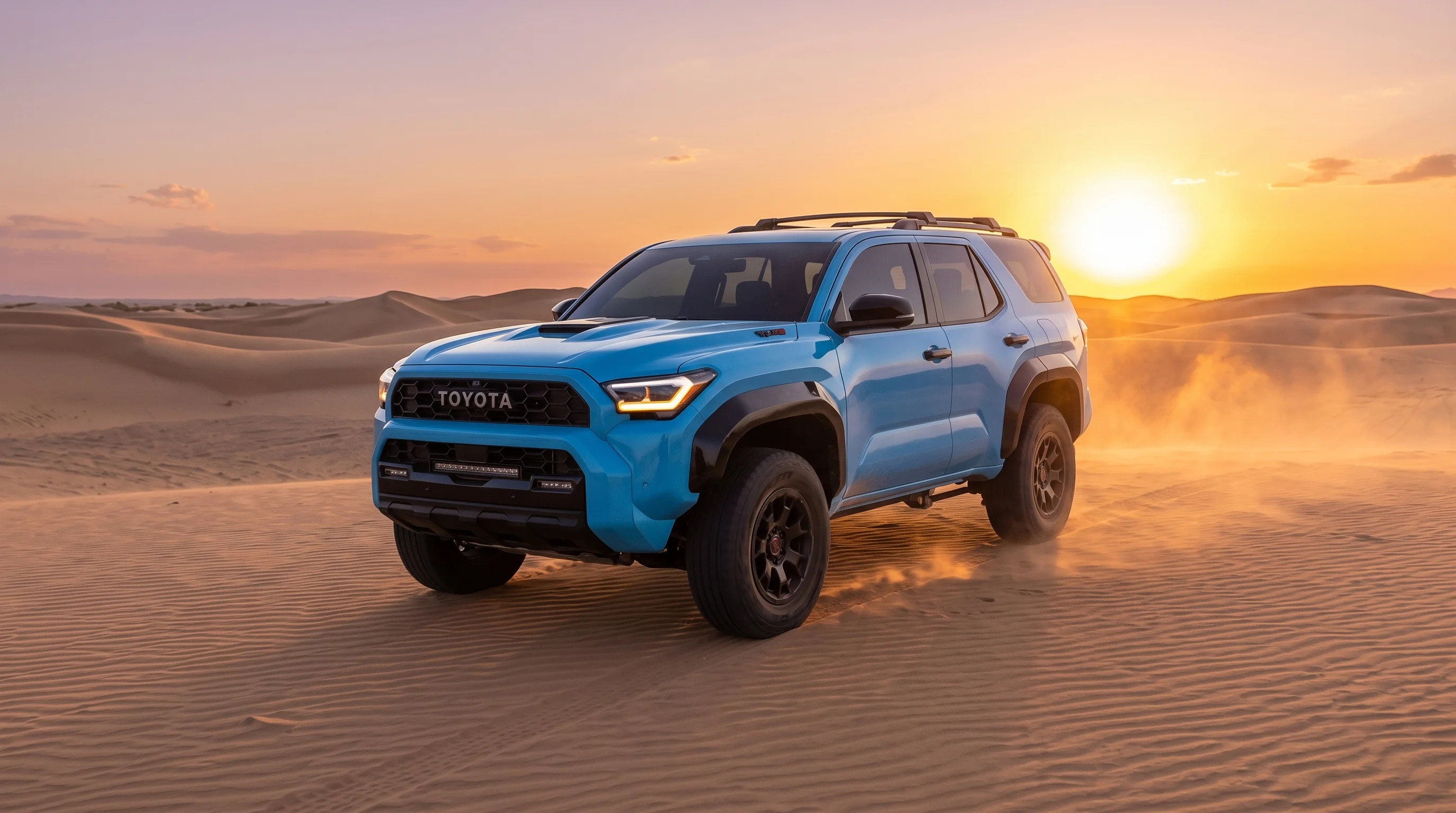
The two 2026 Toyota 4Runner powertrains share the same 2.4-liter turbocharged four-cylinder at their core. What separates them is what Toyota adds on top. The i-FORCE MAX hybrid adds electric assist. It gains 48 horsepower and 148 lb-ft of torque. The standard i-FORCE goes without the hybrid hardware. In exchange it keeps more cargo room and the option of a third row.
For drivers across San Juan Capistrano, Mission Viejo, and Ladera Ranch, the choice comes down to three questions. How much low-end pull do you need? How much do you carry? How many people ride along? We take them in that order.
How Much More Power Does the i-FORCE MAX Add?
The i-FORCE MAX hybrid produces up to 326 horsepower and 465 lb-ft of torque. The standard i-FORCE turbocharged four-cylinder produces 278 horsepower and 317 lb-ft. Both figures come from Toyota’s 2026 4Runner product information. That is a gain of 48 horsepower and 148 lb-ft, and the torque figure is the one that changes how the vehicle feels.
Peak torque arrives at 1,700 rpm on both powertrains, per Edmunds’ 2026 4Runner specifications. Electric assist contributes right away. So the hybrid pulls without waiting on boost. You feel it merging into fast traffic, pulling away from a stop with a full load, and easing over an obstacle at crawl speed.
Both powertrains send power through the same eight-speed automatic. There is no manual transmission in the 2026 4Runner lineup.
Powertrain Specifications Side by Side
| Specification | i-FORCE (Gas) | i-FORCE MAX (Hybrid) |
|---|---|---|
| Engine | 2.4L turbocharged four-cylinder | 2.4L turbocharged four-cylinder with electric assist |
| Horsepower | 278 hp | Up to 326 hp |
| Torque | 317 lb-ft at 1,700 rpm | 465 lb-ft at 1,700 rpm |
| Transmission | 8-speed automatic | 8-speed automatic |
| Drivetrain | Rear-wheel drive standard; four-wheel drive available | Four-wheel drive standard |
| EPA-estimated fuel economy | 20 city / 26 highway / 22 combined | 23 city / 24 highway / 23 combined |
| Maximum towing, properly equipped | Up to 6,000 lbs | Up to 6,000 lbs |
| 2,400-watt AC power supply | Not offered | Standard, cabin and cargo area |
EPA-estimated fuel economy figures are for comparison purposes only. Your actual mileage will vary depending on driving conditions, how you drive and maintain your vehicle, battery age/condition, and other factors.
Maximum towing and payload capacity figures are based on properly equipped vehicles and vary by configuration. Do not exceed any weight rating. See your owner’s manual and the vehicle’s door-jamb label for specific capacities.
The i-FORCE MAX is a self-charging hybrid, not a plug-in. Its battery recharges as you drive, through regenerative braking and the gasoline engine. There are no cables, no home charger to install, and no public charging stops.
Towing and Onboard Power
Towing Capacity
Towing is not the difference many shoppers expect. Both powertrains tow up to 6,000 pounds when properly equipped. That figure is confirmed by Toyota, Edmunds, and Kelley Blue Book. Choosing the hybrid does not cost you towing capacity, and choosing the gas engine does not gain you any.
Maximum towing and payload capacity figures are based on properly equipped vehicles and vary by configuration. Do not exceed any weight rating. See your owner’s manual and the vehicle’s door-jamb label for specific capacities.
What the hybrid changes is how the load feels. Its 148 lb-ft torque advantage arrives low in the rev range. That is where a loaded vehicle asks for it: getting a trailer moving, holding speed on a grade, crawling over rough ground.
Onboard AC Power
The clearer gap is electrical. Every i-FORCE MAX includes a standard 2,400-watt AC power supply. It serves both the cabin and the cargo area, per Toyota’s 2026 4Runner product information. That runs tools or camp gear without a generator. The gas i-FORCE does not offer it at any grade.
Cargo and Seating: What the Hybrid Hardware Costs You
The i-FORCE MAX carries its hybrid battery under the rear cargo floor. That placement has two costs. Together they make the strongest case for the gas engine.
Cargo Volume
Hybrid models offer 42.6 cubic feet behind the second row. Fold that row and the total reaches 82.6 cubic feet. Gas models offer 48.4 and 90.2 cubic feet. Both sets of figures appear on Edmunds’ 2026 4Runner Hybrid and 2026 4Runner spec pages. The battery also lifts the load floor. So the hybrid folds to a slightly stepped surface, where the gas model folds flat. If you haul long, flat cargo, that step matters more than the cubic feet.
Passenger Seating
Seating is the harder trade. Every i-FORCE MAX seats five in two rows. The gas 4Runner offers an available third row. That lifts it to seven passengers. No hybrid 4Runner can be ordered with a third row, at any grade or price.
| Configuration | i-FORCE (Gas) | i-FORCE MAX (Hybrid) |
|---|---|---|
| Cargo behind second row | 48.4 cu. ft. | 42.6 cu. ft. |
| Maximum cargo, seats folded | 90.2 cu. ft. | 82.6 cu. ft. |
| Load floor with second row folded | Flat | Slightly stepped |
| Standard seating | 5 passengers | 5 passengers |
| Available third row | Yes, up to 7 passengers | Not offered |
For a closer look at dimensions, materials, and cabin technology, see our 2026 4Runner interior and cargo specs.
Which Grades Offer Each Powertrain
The i-FORCE MAX is standard on three grades. It is available on three more. The last three grades are gas only. Grade availability follows Toyota’s 2026 4Runner product information; drivetrain availability follows Cars.com’s 2026 4Runner specifications.
| Grade | Powertrain Availability | Drivetrain |
|---|---|---|
| SR5 | i-FORCE gas only | Rear-wheel drive or four-wheel drive |
| TRD Sport | i-FORCE gas only | Rear-wheel drive or four-wheel drive |
| TRD Sport Premium | i-FORCE gas only | Rear-wheel drive or four-wheel drive |
| TRD Off-Road | i-FORCE gas or i-FORCE MAX hybrid | Four-wheel drive |
| TRD Off-Road Premium | i-FORCE gas or i-FORCE MAX hybrid | Four-wheel drive |
| Limited | i-FORCE gas or i-FORCE MAX hybrid | Rear-wheel drive or four-wheel drive |
| Platinum | i-FORCE MAX hybrid standard | Four-wheel drive |
| Trailhunter | i-FORCE MAX hybrid standard | Four-wheel drive |
| TRD Pro | i-FORCE MAX hybrid standard | Four-wheel drive |
The TRD Off-Road is the entry point for the hybrid. Want the i-FORCE MAX without stepping into the top of the lineup? That is where it starts. For a full trim-by-trim breakdown with starting TSRP, see our 2026 4Runner trims and pricing guide.
Off-Road Hardware: A Shared Baseline and Two Hybrid Flagships
For most of the lineup, off-road capability is not a hybrid-versus-gas question. A gas TRD Off-Road and a hybrid TRD Off-Road carry the same four-wheel-drive hardware. It is standard on both, per Edmunds’ TRD Off-Road specifications.
Part-Time 4WD
Standard on the TRD Off-Road with either powertrain.
Two-Speed Transfer Case
Electronic high and low range selection for steep, low-traction terrain.
Locking Rear Differential
An electronically locking rear differential, standard on the TRD Off-Road.
Downhill Descent Control
Holds a controlled speed on steep descents so you can concentrate on steering.
The powertrains diverge at the top of the range. The two most specialized 4Runners are hybrid-only. Both are detailed in Toyota’s 2026 4Runner product information.
TRD Pro
Built for speed and technical terrain. It rides on TRD-tuned FOX QS3 three-way adjustable internal-bypass shocks. Tires are 33-inch Toyo on 18-inch wheels. A standard Stabilizer Disconnect Mechanism frees front suspension travel at the push of a button.
Trailhunter
Built for multi-day overlanding. It pairs Old Man Emu forged monotube shocks with remote reservoirs. It runs the same 33-inch Toyo tires on 18-inch wheels. The Stabilizer Disconnect Mechanism is standard here too.
The Stabilizer Disconnect Mechanism is standard on the TRD Pro and the Trailhunter. It is now an option on the i-FORCE MAX TRD Off-Road Premium.
Safety and Warranty Coverage
Toyota Safety Sense 3.0
Toyota Safety Sense 3.0 is standard on every 2026 4Runner, hybrid or gas, per Toyota’s 2026 4Runner product information. Neither powertrain asks you to compromise on driver assistance. The suite includes:
- Pre-Collision System with Pedestrian Detection
- Lane Departure Alert with Steering Assist
- Full-Speed Range Dynamic Radar Cruise Control
- Lane Tracing Assist
- Road Sign Assist
- Automatic High Beams
- Proactive Driving Assist
Driver-assistance and advanced safety systems are supplemental aids and are not substitutes for safe and attentive driving. Availability, operation, and effectiveness vary by trim and equipment and depend on factors including road, weather, traffic, and vehicle condition. Always keep your hands on the wheel and your eyes on the road. See your owner’s manual for system limitations and details.
Factory Warranty and Maintenance
The terms below come from Edmunds’ 2026 4Runner warranty listing. Hybrid battery coverage comes from Toyota’s electrified vehicle warranty page.
| Coverage | Term | Applies To |
|---|---|---|
| Basic (bumper-to-bumper) | 3 years / 36,000 miles | Every 2026 4Runner |
| Powertrain | 5 years / 60,000 miles | Every 2026 4Runner |
| Corrosion perforation | 5 years / unlimited miles | Every 2026 4Runner |
| ToyotaCare scheduled maintenance | 2 years / 25,000 miles | Every 2026 4Runner |
| Roadside assistance | 2 years / unlimited miles | Every 2026 4Runner |
| Hybrid battery | 10 years / 150,000 miles | i-FORCE MAX only |
This information is provided for general educational purposes only and does not constitute legal advice. Warranty coverage depends on the specific terms of your vehicle’s warranty agreement. Consult your owner’s manual or a qualified legal professional for guidance on your individual situation.
Which 2026 4Runner Fits You?
Choose the i-FORCE MAX Hybrid
Pick the hybrid for low-end torque, the better EPA-estimated city figure, standard four-wheel drive, and 2,400 watts of onboard AC power. It is the right tool if you tow, crawl, or camp. It is also the only way into the Trailhunter and TRD Pro. You give up about six cubic feet behind the second row, plus the option of a third row.
Choose the Gas i-FORCE
Pick the gas engine if cargo room, a flat folded floor, or seven-passenger seating matters more than torque. It is the only path to the SR5, TRD Sport, and TRD Sport Premium. It is also the only way to get a third row. Gas models post the best EPA-estimated highway figure in the lineup at 26 mpg.
EPA-estimated fuel economy figures are for comparison purposes only. Your actual mileage will vary depending on driving conditions, how you drive and maintain your vehicle, battery age/condition, and other factors.
Towing is identical at up to 6,000 pounds properly equipped. Off-road hardware in the shared grades is the same. Toyota Safety Sense 3.0 is standard on both. Neither choice is a compromise on capability or safety.
Maximum towing and payload capacity figures are based on properly equipped vehicles and vary by configuration. Do not exceed any weight rating. See your owner’s manual and the vehicle’s door-jamb label for specific capacities.
For deeper detail on either powertrain, see our 2026 4Runner engine specs and towing capacity guide or the 2026 4Runner i-FORCE MAX buyer’s guide.
Frequently Asked Questions
Does the 2026 Toyota 4Runner hybrid require a 240-volt home charger?
No. The 2026 4Runner i-FORCE MAX is a self-charging hybrid and never needs to be plugged in. Its battery recharges automatically while you drive, using regenerative braking and the gasoline engine, so no wall outlet, home charger installation, or public charging stop is required.
How much can the 2026 Toyota 4Runner tow?
Properly equipped, both the gas i-FORCE and the i-FORCE MAX hybrid are rated to tow up to 6,000 pounds. Towing capacity is not a point of difference between the two powertrains.
Maximum towing and payload capacity figures are based on properly equipped vehicles and vary by configuration. Do not exceed any weight rating. See your owner’s manual and the vehicle’s door-jamb label for specific capacities.
Can you get a third row in the 2026 4Runner hybrid?
No. Every i-FORCE MAX is a two-row, five-passenger configuration, because the hybrid battery occupies the space beneath the rear cargo floor. The available third row is offered only on gas models, which seat up to seven.
How does the hybrid cargo area differ from the gas model?
The hybrid offers 42.6 cubic feet behind the second row and 82.6 cubic feet maximum, against 48.4 and 90.2 cubic feet for gas models. The battery beneath the floor also leaves a slightly stepped surface when the second row folds, where gas models fold flat.
What safety features come standard on the 2026 Toyota 4Runner?
Every 2026 4Runner includes Toyota Safety Sense 3.0 as standard equipment, covering Pre-Collision System with Pedestrian Detection, Lane Departure Alert with Steering Assist, Full-Speed Range Dynamic Radar Cruise Control, Lane Tracing Assist, Road Sign Assist, Automatic High Beams, and Proactive Driving Assist.
Driver-assistance and advanced safety systems are supplemental aids and are not substitutes for safe and attentive driving. Availability, operation, and effectiveness vary by trim and equipment and depend on factors including road, weather, traffic, and vehicle condition. Always keep your hands on the wheel and your eyes on the road. See your owner’s manual for system limitations and details.
Compare Both 2026 4Runner Powertrains at Capistrano Valley Toyota
Driving them back to back is the fastest way to settle this. The torque gap shows up at the first stoplight. The cargo gap shows up the moment you open the tailgate. Visit us at 33395 Camino Capistrano in San Juan Capistrano to drive both in one stop. Or contact our sales team to check what we have in the grade you want.
Disclaimers
EPA-estimated fuel economy figures are for comparison purposes only. Your actual mileage will vary depending on driving conditions, how you drive and maintain your vehicle, battery age/condition, and other factors.
Maximum towing and payload capacity figures are based on properly equipped vehicles and vary by configuration. Do not exceed any weight rating. See your owner’s manual and the vehicle’s door-jamb label for specific capacities.
Driver-assistance and advanced safety systems are supplemental aids and are not substitutes for safe and attentive driving. Availability, operation, and effectiveness vary by trim and equipment and depend on factors including road, weather, traffic, and vehicle condition. Always keep your hands on the wheel and your eyes on the road. See your owner’s manual for system limitations and details.
This information is provided for general educational purposes only and does not constitute legal advice. Warranty coverage depends on the specific terms of your vehicle’s warranty agreement. Consult your owner’s manual or a qualified legal professional for guidance on your individual situation.