


2026 Toyota C-HR: Features, Specs, Range and Trims
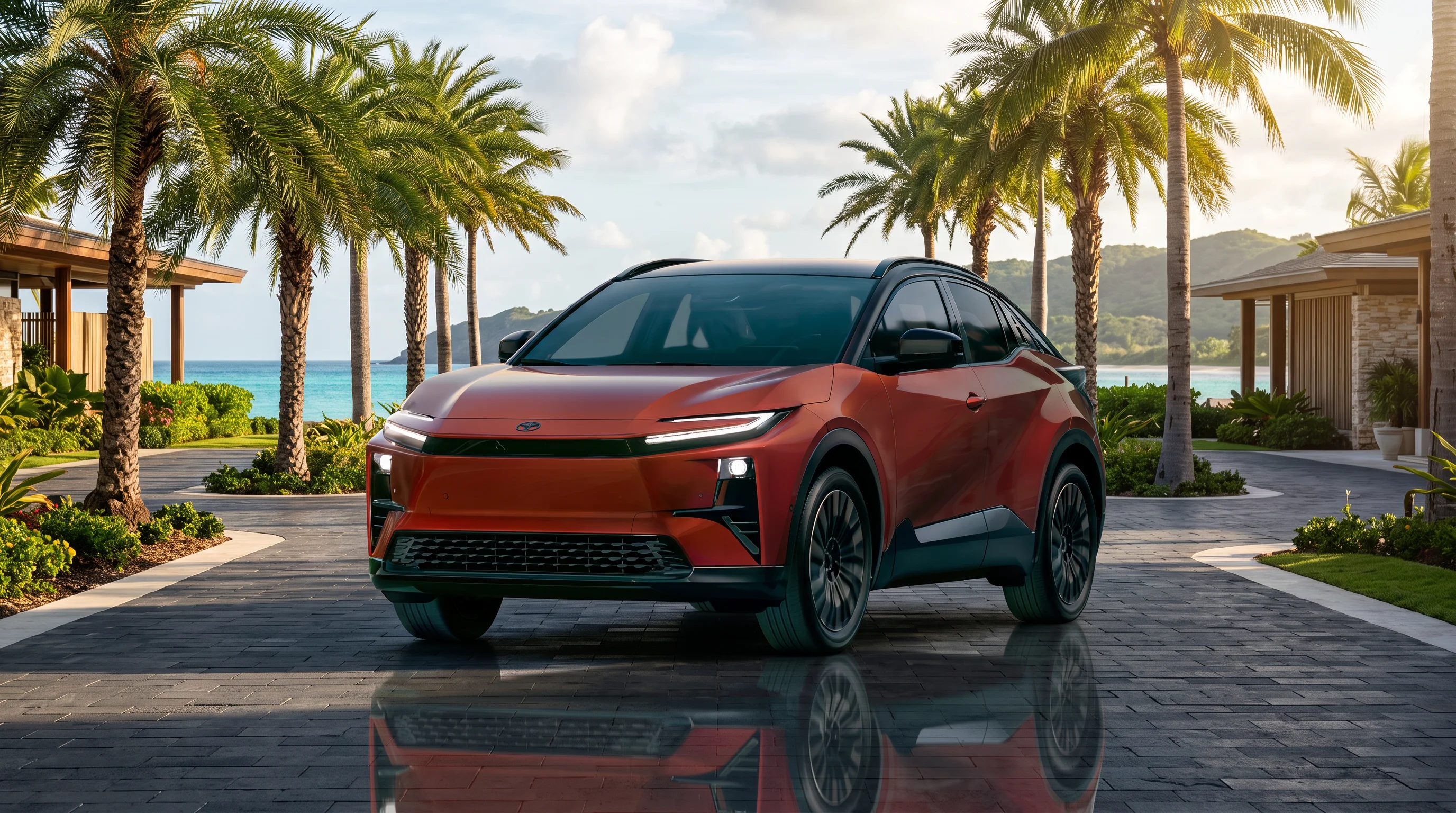
The C-HR nameplate returns to the U.S. lineup for 2026 as an all-new battery-electric crossover. It is built on Toyota’s dedicated e-TNGA battery electric platform. That is the same architecture used by the bZ and bZ Woodland. The battery mounts under the floor, and the body wears a wide, coupe-like profile. The result is a low center of gravity and a stance far sportier than the first-generation gas C-HR.
Toyota’s signature hammerhead front end flows into a compact cabin and an angular rear. Inside, the layout is clean and open. You get a slim driver’s display, an easy-to-access center console, and customizable ambient lighting. For shoppers moving into their first EV, the C-HR is an accessible entry point. It does not ask you to trade away performance.
Dual-Motor Powertrain and 338 Horsepower
Every 2026 C-HR sold in the U.S. is battery-electric. There is no gasoline version and no conventional hybrid. Power comes from electric motors housed in the front and rear eAxles. Together they make 338 net combined system horsepower. Torque measures 198 lb-ft at the front motor and 125 lb-ft at the rear. Toyota estimates 0 to 60 mph in 4.9 seconds.
A 74.7-kWh lithium-ion battery sits under the floor. A cross-framing structure surrounds it and adds rigidity to the body. Toyota tuned the suspension specifically for the C-HR, including spring and damper performance and anti-roll bar stiffness. Paddle shifters on the steering wheel adjust regenerative braking across four levels.
| Specification | 2026 Toyota C-HR |
|---|---|
| Powertrain | Dual electric motors, front and rear eAxles |
| Combined output | 338 net combined system horsepower |
| Torque | 198 lb-ft front motor / 125 lb-ft rear motor |
| 0–60 mph | 4.9 seconds (manufacturer-estimated) |
| Drivetrain | Standard electronic All-Wheel Drive |
| Battery | 74.7-kWh lithium-ion |
| Onboard AC charger | 11-kW |
| DC fast charging | 10% to 80% in around 30 minutes |
| Level 2 charging | 10% to 100% in around 7 hours |
| Charge port | North American Charging Standard (NACS) |
Specifications, features and availability are current as of publication and are subject to change at any time. All figures are sourced from Toyota’s official 2026 C-HR product information.
EPA-Estimated Electric Range, Charging and Standard All-Wheel Drive
All-wheel drive is standard on every 2026 Toyota C-HR. The dual-motor layout places one motor at each axle. Torque moves electronically between front and rear, not through a mechanical transfer case.
EPA-estimated range varies by grade because wheel and tire packages affect efficiency. The SE rides on 18-inch wheels. It carries an EPA-estimated 287 miles of total driving range and an EPA-estimated 117 MPGe combined. The XSE rides on 20-inch wheels. It is EPA-estimated at 273 miles and 112 MPGe combined.
For drivers across San Juan Capistrano, Mission Viejo, Aliso Viejo and Laguna Niguel, standard all-wheel drive earns its keep during seasonal rainstorms. Toyota notes that actual range varies with outside temperature, speed and driving conditions. In Orange County’s mild climate, that tends to matter less than it does in cold-weather markets.
Every C-HR includes a North American Charging Standard (NACS) charge port. That opens up DC fast-charging stations and Level 2 chargers nationwide. Two charge port adapters are included: a J1772 adapter for Level 1 and Level 2 AC charging, and a CCS1 adapter for Level 3 DC fast charging. On a DC fast charger, the battery goes from 10% to 80% in around 30 minutes under ideal conditions. On a Level 2 source, the standard 11-kW onboard AC charger takes a 10% to 100% charge to around seven hours. Plug & Charge capability and battery preconditioning are both standard. Plug & Charge requires an active Remote Connect trial or subscription and is 4G network dependent; a three-year trial is included. Battery preconditioning can be activated manually through system settings, and automatic activation requires an active Drive Connect trial or subscription.
EPA-estimated fuel economy figures are for comparison purposes only. Your actual mileage will vary depending on driving conditions, how you drive and maintain your vehicle, battery age/condition, and other factors.
14-Inch Touchscreen, Connected Technology and Cargo Space
Every grade comes with a 14-inch touchscreen running Toyota Audio Multimedia. You also get a fully digital gauge cluster, two front wireless phone chargers and four USB-C ports. The included three-year Drive Connect trial adds Cloud Navigation and Destination Assist. It also adds Intelligent Assistant, which responds to spoken commands after a “Hey Toyota” prompt. Wireless Apple CarPlay and Android Auto compatibility are standard.
A six-speaker audio system is standard. The XSE offers an available JBL Premium Audio system. It runs nine speakers, an 800-watt eight-channel amplifier and a nine-inch subwoofer.
The C-HR measures 177.9 inches long and 73.6 inches wide. It stands 63.8 inches tall and rides on a 108.3-inch wheelbase. Behind the 60/40 split-folding rear seats there is 25.3 cubic feet of cargo space. Fold the seatbacks flat and that grows to 59.5 cubic feet. That is enough for a shopping trip to the Shops at Mission Viejo or a weekend’s worth of gear.
2026 Toyota C-HR Trim Levels: SE vs. XSE
The 2026 C-HR is offered in two grades. Both share the same battery, motors, horsepower and standard all-wheel drive. So the decision comes down to wheels, interior materials and driver-assist content, not performance.
2026 Toyota C-HR SE
TSRP: $38,450*
EPA-estimated range: 287 miles
EPA-estimated efficiency: 117 MPGe combined
Wheels: 18-inch with black inserts
Seating: Fabric and SofTex-trimmed, 8-way power driver seat, 6-way manual passenger seat
The SE also includes a power back door, rain-sensing wipers and low-profile roof rails. Heated front seats and a heated steering wheel are standard. So are Toyota Safety Sense 3.0, Front and Rear Parking Assist with Automatic Braking, and Blind Spot Monitor.
2026 Toyota C-HR XSE
TSRP: $40,450*
EPA-estimated range: 273 miles
EPA-estimated efficiency: 112 MPGe combined
Wheels: 20-inch gunmetal-finished
Seating: SofTex and synthetic suede-trimmed, 8-way power passenger seat, driver memory seat
The XSE adds Traffic Jam Assist, Lane Change Assist and a Panoramic View Monitor. Traffic Jam Assist requires an active Drive Connect trial or subscription and is 4G network dependent. A fixed-glass panoramic moonroof with power sunshade is available.
*Total Suggested Retail Price (TSRP) for new vehicles includes manufacturer and distributor options and delivery, processing, and handling fees, which are subject to change at any time. TSRP excludes taxes, title, license, dealer-installed options, accessories, fees and charges. TSRP is not the dealer advertised price. Dealer price will vary. The dealer sets the final price.
EPA-estimated fuel economy figures are for comparison purposes only. Your actual mileage will vary depending on driving conditions, how you drive and maintain your vehicle, battery age/condition, and other factors.
Standard Safety: Toyota Safety Sense 3.0
Toyota Safety Sense 3.0 is standard on every 2026 C-HR. These systems assist the driver. They are not a substitute for safe and attentive driving.
- Pre-Collision System with Pedestrian Detection — can detect a vehicle, pedestrian, bicyclist or motorcyclist and provide automatic emergency braking under certain conditions
- Full-Speed Range Dynamic Radar Cruise Control — an adaptive cruise system designed to be set at speeds above 20 mph that helps maintain a preset following distance
- Lane Departure Alert with Steering Assist — detects lane markings or the road’s edge above 30 mph
- Lane Tracing Assist — helps keep the vehicle centered in its lane while Dynamic Radar Cruise Control is in use
- Proactive Driving Assist — provides gentle braking or steering support, including braking into curves
- Road Sign Assist — recognizes speed limit, stop and yield signs and displays them on the Multi-Information Display
- Automatic High Beams — toggle between high and low beams based on surrounding traffic
Every C-HR adds more safety equipment beyond the Toyota Safety Sense suite. Blind Spot Monitor with Rear Cross-Traffic Alert is standard. So are Front and Rear Parking Assist with Automatic Braking, Safe Exit Alert, and the Toyota Star Safety System.
Common Questions About the 2026 Toyota C-HR
How long does it take to charge the C-HR at home?
Using a Level 2 charging source paired with the vehicle’s standard 11-kW onboard AC charger, charging from 10% to 100% takes around seven hours. That makes overnight charging practical for most daily driving. A dual-voltage 120V/240V charging cable is included, and a 240V outlet installed by a licensed electrician is required for Level 2 charging at home.
Does the 2026 Toyota C-HR qualify for a federal tax credit?
No. The federal clean vehicle credit under IRC Section 30D was terminated by Public Law 119-21 for vehicles acquired after September 30, 2025, so 2026 purchases do not qualify. California’s statewide Clean Vehicle Rebate Project also stopped accepting new applications in November 2023. Remaining California programs are largely income-qualified, and utility rebates vary by provider and ZIP code. Separately, California’s Clean Air Vehicle decal program ended on September 30, 2025, so a zero-emission vehicle no longer grants single-occupant access to HOV lanes. Check current program status directly before making a purchase decision.
What is the battery warranty on the 2026 C-HR?
According to Toyota’s published limited warranty terms for the 2026 C-HR, the Electric Vehicle Driving Components, including the traction battery, are covered for 8 years or 100,000 miles, whichever comes first. That coverage sits alongside Toyota’s 36-month/36,000-mile basic new-vehicle warranty and 60-month/60,000-mile powertrain warranty. Every C-HR also includes ToyotaCare, covering normal factory-scheduled maintenance for two years or 25,000 miles, plus three years of roadside assistance regardless of mileage.
How does cargo space compare to the previous gasoline C-HR?
The electric C-HR is meaningfully more practical. It offers 25.3 cubic feet behind the rear seats, compared with 19.1 cubic feet in the 2018–2022 gasoline C-HR, and 59.5 cubic feet with the seats folded flat versus 37 cubic feet in the outgoing model.
This information is provided for general educational purposes only and does not constitute legal advice. Warranty coverage depends on the specific terms of your vehicle’s warranty agreement. Consult your owner’s manual or a qualified legal professional for guidance on your individual situation.
See the 2026 Toyota C-HR in San Juan Capistrano
The 2026 C-HR brings 338 net combined system horsepower and standard all-wheel drive. It adds up to an EPA-estimated 287 miles of range and a 14-inch touchscreen, with every figure here drawn from Toyota’s published specifications for the 2026 C-HR. Whether the SE or the XSE fits better usually comes down to how much the wheels, interior materials and added driver-assist features matter to you.
Our team at our San Juan Capistrano showroom can walk you through both grades side by side. We can also answer questions about range, charging and what home charging would look like for your commute. For more Toyota model breakdowns, browse our Toyota model research hub.