


Toyota Prius Plug-in Hybrid vs Corolla Cross Hybrid: Which Is Better for Daily Commuting?
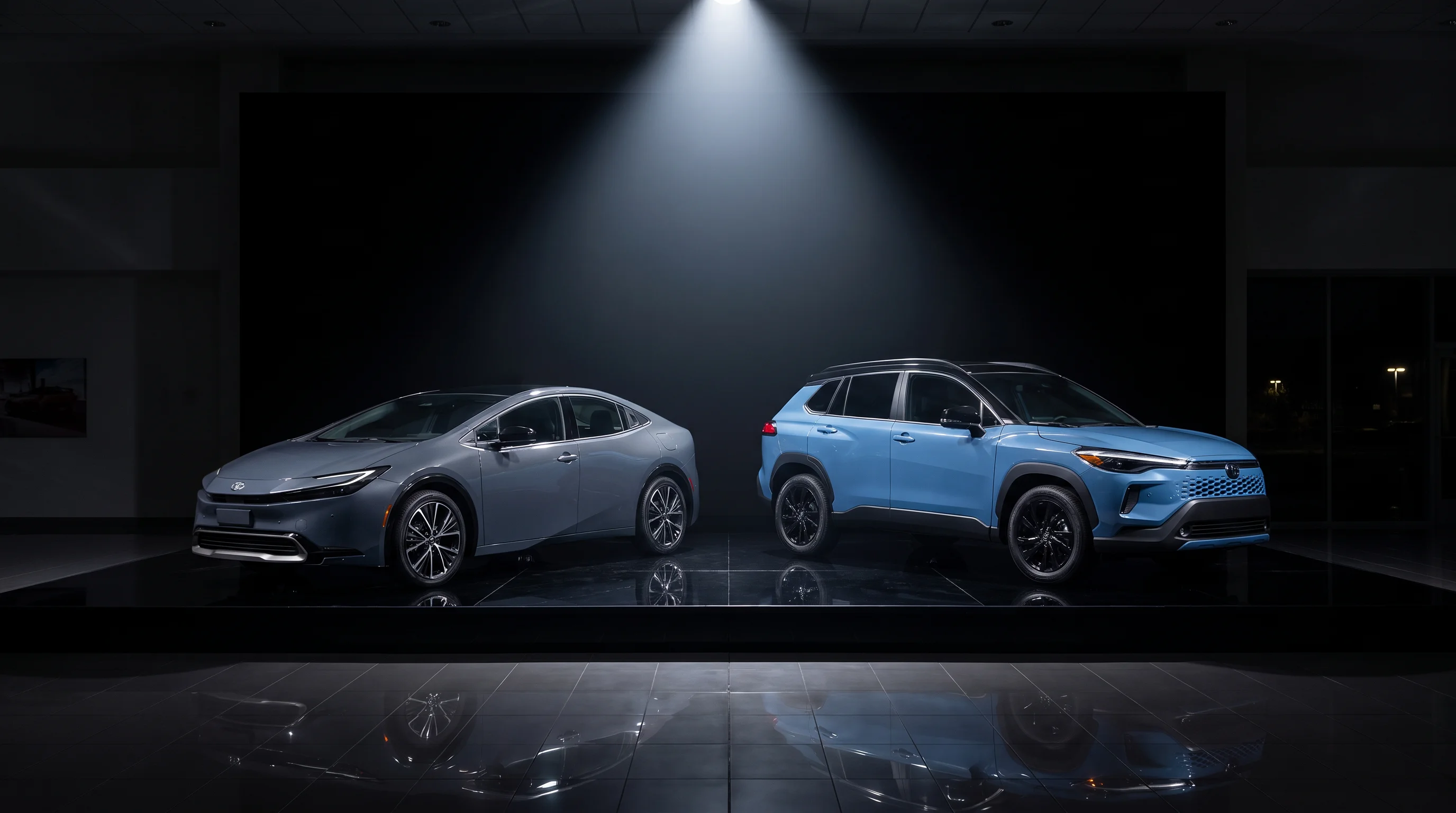
For daily commuting in San Juan Capistrano, the Toyota Prius Plug-in Hybrid is the better choice for drivers who can charge at home and want up to an EPA-estimated 44 miles of all-electric driving. The Toyota Corolla Cross Hybrid is the better choice for commuters who want standard all-wheel drive, a higher seating position, and more cargo room without ever plugging in. Both are efficient, but they suit two different daily routines.
EPA-estimated fuel economy figures are for comparison purposes only. Your actual mileage will vary depending on driving conditions, how you drive and maintain your vehicle, battery age/condition, and other factors.
One note on naming before we go further: the plug-in Prius was called the Prius Prime through the 2024 model year. Toyota renamed it the Prius Plug-in Hybrid beginning with 2025, so if you have been shopping for a Prius Prime, this is the same vehicle under its current name.
At a Glance: 2026 Prius Plug-in Hybrid vs 2026 Corolla Cross Hybrid
| Specification | 2026 Prius Plug-in Hybrid | 2026 Corolla Cross Hybrid |
|---|---|---|
| Powertrain | 2.0L four-cylinder plug-in hybrid | 2.0L four-cylinder hybrid |
| Horsepower | 220 hp combined | 196 hp combined |
| Drivetrain | Front-wheel drive | Electronic On-Demand AWD (standard) |
| Plug-in capability | Yes | No |
| EPA-Estimated electric range | Up to 44 miles (SE) | Not applicable |
| EPA-Estimated MPGe | 127 MPGe (SE) | Not rated |
| EPA-Estimated combined MPG | 52 mpg (SE) | 42 mpg |
| Length | 181.1 in. | 176.8 in. |
| Height | 55.9 in. (SE) | 64.9 in. |
| Ground clearance | 5.6 in. (SE) | 8.0 in. |
| Rear legroom | 35.9 in. | 32.0 in. |
| Cargo behind second row | 20.3 cu. ft. | 21.5 cu. ft. |
| Maximum towing | Not rated for towing | 1,500 lbs.* |
| Starting TSRP | $35,070* | $31,390* |
*Total Suggested Retail Price (TSRP) for new vehicles includes manufacturer and distributor options and delivery, processing, and handling fees, which are subject to change at any time. TSRP excludes taxes, title, license, dealer-installed options, accessories, fees and charges. TSRP is not the dealer advertised price. Dealer price will vary. The dealer sets the final price.
EPA-estimated fuel economy figures are for comparison purposes only. Your actual mileage will vary depending on driving conditions, how you drive and maintain your vehicle, battery age/condition, and other factors.
Maximum towing and payload capacity figures are based on properly equipped vehicles and vary by configuration. Do not exceed any weight rating. See your owner’s manual and the vehicle’s door-jamb label for specific capacities.
2026 Prius Plug-in Hybrid
The Prius Plug-in Hybrid pairs a 2.0-liter four-cylinder engine with a 13.6-kWh lithium-ion battery and dual electric motor-generators for a combined 220 horsepower and 139 lb-ft of torque, driving the front wheels through an electronically controlled continuously variable transmission. When the battery is depleted, it runs as a conventional hybrid and returns an EPA-estimated 52 mpg combined on the SE grade.
2026 Corolla Cross Hybrid
The Corolla Cross Hybrid uses a 2.0-liter four-cylinder engine with three electric motors for a net 196 horsepower, and it never needs a charging cable. It recovers energy through regenerative braking and engine-driven generation, earning an EPA-estimated 46 mpg city, 39 mpg highway, and 42 mpg combined. Its defining advantage is Electronic On-Demand all-wheel drive, standard on all three grades, which sends power to the rear wheels when traction drops. Toyota designs this system for slippery road surfaces rather than off-road use.
EPA-estimated fuel economy figures are for comparison purposes only. Your actual mileage will vary depending on driving conditions, how you drive and maintain your vehicle, battery age/condition, and other factors.
For a closer look at either vehicle on its own, see our 2026 Toyota Prius features review and our 2026 Toyota Corolla Cross fuel efficiency guide.
What Is the Difference Between MPG and MPGe?
Miles per gallon measures how far a vehicle travels on one gallon of gasoline. MPGe, or miles per gallon of gasoline equivalent, converts electricity consumption into a comparable figure so shoppers can measure an electrified vehicle against a gasoline one.
The EPA created MPGe for exactly this purpose. One gallon of gasoline holds roughly the same energy as 33.7 kilowatt-hours of electricity. Running on battery power alone, the 2026 Prius Plug-in Hybrid SE earns an EPA-estimated 127 MPGe. Higher grades are rated at an EPA-estimated 114 MPGe. Once the plug-in battery reaches its reserve, the vehicle switches to hybrid operation and its rating becomes an EPA-estimated 52 mpg combined on the SE, or an EPA-estimated 48 mpg combined on the XSE, Nightshade Edition, and XSE Premium.
The Corolla Cross Hybrid carries no MPGe rating because it cannot be charged from an outlet. It operates only as a gasoline-electric hybrid at an EPA-estimated 42 mpg combined, and it delivers that figure while moving a taller crossover body with all-wheel drive standard.
MPG
Distance traveled per gallon of gasoline during combustion or combined hybrid operation.
MPGe
Distance traveled per 33.7 kWh of electricity during EV-only operation.
The Handoff
A plug-in hybrid is measured in MPGe while running on battery, then in MPG once it operates as a conventional hybrid.
EPA-estimated fuel economy figures are for comparison purposes only. Your actual mileage will vary depending on driving conditions, how you drive and maintain your vehicle, battery age/condition, and other factors.
Electric Range, Charging Time, and How Each System Works
The EPA rates the Prius Plug-in Hybrid SE at up to an EPA-estimated 44 miles of all-electric range. The XSE, Nightshade Edition, and XSE Premium are rated at an EPA-estimated 39 miles. The Corolla Cross Hybrid has no plug-in capability and runs on its gasoline engine and regenerative braking alone.
The question first-time plug-in shoppers ask most often is whether a 240-volt outlet has to be installed before anything else. It does not. The Prius Plug-in Hybrid comes with a dual-voltage charging cable that works with an ordinary 120-volt household outlet, filling the battery in about 11 hours overnight. A Level 2 240-volt charger cuts that to roughly 4 hours. Once the electric range is used up, the car does not lose performance or stall out. It simply continues as a conventional hybrid on its 2.0-liter engine and electric drive system.
The Corolla Cross Hybrid works on a different principle. With no charge port, there are no charging schedules to manage and no home equipment to buy. Its battery replenishes itself through regenerative braking, which captures energy normally lost when slowing down, and through generator output from the 2.0-liter engine.
EPA-estimated fuel economy figures are for comparison purposes only. Your actual mileage will vary depending on driving conditions, how you drive and maintain your vehicle, battery age/condition, and other factors.
Passenger Space and Cargo Room Compared
The Prius Plug-in Hybrid gives rear passengers more legroom at 35.9 inches versus 32.0 inches in the Corolla Cross Hybrid. The Corolla Cross Hybrid answers with more usable cargo room and a far easier load height.
The Prius Plug-in Hybrid measures 181.1 inches long and 55.9 inches tall on the SE grade, with 5.6 inches of ground clearance. That low, aerodynamic shape is central to its efficiency. Behind the rear hatch there are 20.3 cubic feet of cargo space, which expands to 26.7 cubic feet with the rear seats folded.
The Corolla Cross Hybrid stands 64.9 inches tall on a 176.8-inch length, with 8.0 inches of ground clearance. Rear legroom is tighter, but the upright roofline opens up rear headroom and makes the cabin feel airier. Cargo space measures 21.5 cubic feet behind the second row, and the tall opening and higher load floor make bulky items easier to slide in than the Prius Plug-in Hybrid’s lower hatch allows. For shoppers in Aliso Viejo, Laguna Niguel, and Dana Point heading toward Aliso and Wood Canyons Wilderness Park with hiking or sports gear, that shape is the practical difference.
Trim Levels and Pricing Compared
The Prius Plug-in Hybrid is offered in four grades for 2026. The Corolla Cross Hybrid is offered in three, and every one of them includes all-wheel drive at no extra cost.
2026 Toyota Prius Plug-in Hybrid Grades
| Grade | TSRP* | EPA-Estimated Electric Range | EPA-Estimated Combined MPG | Key Additions |
|---|---|---|---|---|
| SE | $35,070* | 44 miles | 52 mpg | 17-in. wheels, Toyota Safety Sense™ 3.0, 8-in. touchscreen |
| XSE | $38,320* | 39 miles | 48 mpg | 19-in. wheels, SofTex®-trimmed seating, heated front seats, wireless charging |
| Nightshade Edition | $39,090* | 39 miles | 48 mpg | Black wheels, badging and exterior trim |
| XSE Premium | $41,765* | 39 miles | 48 mpg | 12.3-in. touchscreen, JBL premium audio, ventilated front seats, power liftgate |
EPA-estimated fuel economy figures are for comparison purposes only. Your actual mileage will vary depending on driving conditions, how you drive and maintain your vehicle, battery age/condition, and other factors.
2026 Toyota Corolla Cross Hybrid Grades
| Grade | TSRP* | Key Additions |
|---|---|---|
| S | $31,390* | Standard Electronic On-Demand AWD, LED projector headlights, 8-in. touchscreen |
| SE | $32,710* | Blind Spot Monitor with Rear Cross-Traffic Alert, wireless charging, paddle shifters, four USB-C ports |
| XSE | $35,425* | 18-in. gloss-black alloy wheels, 10.5-in. touchscreen, 12.3-in. digital gauge cluster, dual-zone climate |
*Total Suggested Retail Price (TSRP) for new vehicles includes manufacturer and distributor options and delivery, processing, and handling fees, which are subject to change at any time. TSRP excludes taxes, title, license, dealer-installed options, accessories, fees and charges. TSRP is not the dealer advertised price. Dealer price will vary. The dealer sets the final price.
The Prius Plug-in Hybrid SE is the efficiency leader of its lineup and comes well equipped, with 17-inch wheels, Toyota Safety Sense 3.0, a heated leather-trimmed steering wheel, six USB-C ports, six speakers, a 7-inch digital gauge cluster, and an 8-inch Toyota Audio Multimedia touchscreen with wireless Apple CarPlay and Android Auto. The XSE steps up to 19-inch wheels, SofTex-trimmed seating, heated front seats, a power driver’s seat, wireless charging, and front and rear parking sensors. The Nightshade Edition builds on the XSE with black wheels, badging, and exterior trim. The XSE Premium adds a 12.3-inch touchscreen, an eight-speaker JBL premium audio system, heated and ventilated front seats, an available fixed panoramic glass roof, a power liftgate, and an available solar charging roof.
On the Corolla Cross Hybrid side, the S grade covers the fundamentals, including standard Electronic On-Demand all-wheel drive, LED projector headlights, an 8-inch touchscreen, and proximity keyless entry. The SE adds Blind Spot Monitor with Rear Cross-Traffic Alert, wireless smartphone charging, a leather-trimmed steering wheel with paddle shifters, automatic climate control, and four USB-C ports. The XSE tops the range with 18-inch gloss-black alloy wheels, a 10.5-inch touchscreen, a 12.3-inch digital gauge cluster, dual-zone automatic climate control, ambient interior lighting, and standard heated front seats and heated steering wheel. For a full grade-by-grade breakdown, see our Toyota Corolla Cross trim levels guide.
Warranty and Ownership Coverage
Both vehicles carry Toyota’s standard new-vehicle coverage, and both include ToyotaCare, the no-cost maintenance plan that covers factory-scheduled service for 2 years or 25,000 miles on 2026 models. ToyotaCare covers the 5,000-, 10,000-, 15,000-, 20,000-, and 25,000-mile services, a maximum of five visits, including oil and filter changes, tire rotations, multi-point inspections, and fluid top-offs.
There is one meaningful difference between the two. Toyota’s 24-hour roadside assistance runs 2 years with unlimited mileage on most models, but plug-in hybrids receive 3 years with unlimited mileage. The Prius Plug-in Hybrid gets the longer term; the Corolla Cross Hybrid gets the standard one.
| Coverage | 2026 Prius Plug-in Hybrid | 2026 Corolla Cross Hybrid |
|---|---|---|
| Basic warranty | 3 years / 36,000 miles | 3 years / 36,000 miles |
| Powertrain warranty | 5 years / 60,000 miles | 5 years / 60,000 miles |
| Hybrid battery warranty | 10 years / 150,000 miles | 10 years / 150,000 miles |
| ToyotaCare scheduled maintenance | 2 years / 25,000 miles | 2 years / 25,000 miles |
| 24-hour roadside assistance | 3 years / unlimited miles | 2 years / unlimited miles |
This information is provided for general educational purposes only and does not constitute legal advice. Warranty coverage depends on the specific terms of your vehicle’s warranty agreement. Consult your owner’s manual or a qualified legal professional for guidance on your individual situation. Warranty and ToyotaCare terms sourced from Toyota Motor Sales, U.S.A. published program materials.
Which One Fits Your Commute?
| If you care most about… | Better pick | Why |
|---|---|---|
| Lowest fuel cost with home charging | Prius Plug-in Hybrid | Up to an EPA-estimated 44 miles of electric range on the SE |
| All-weather traction | Corolla Cross Hybrid | Electronic On-Demand AWD standard on every grade |
| No charging to manage | Corolla Cross Hybrid | No plug-in port, no home charging equipment needed |
| Rear passenger room | Prius Plug-in Hybrid | 35.9 in. of rear legroom versus 32.0 in. |
| Loading bulky gear | Corolla Cross Hybrid | Taller opening, higher load floor, 8.0 in. of ground clearance |
| Lowest entry price | Corolla Cross Hybrid | $31,390 TSRP* versus $35,070 TSRP* |
| Towing a small trailer | Corolla Cross Hybrid | Rated up to 1,500 lbs.*; the Prius Plug-in Hybrid is not rated for towing |
*Total Suggested Retail Price (TSRP) for new vehicles includes manufacturer and distributor options and delivery, processing, and handling fees, which are subject to change at any time. TSRP excludes taxes, title, license, dealer-installed options, accessories, fees and charges. TSRP is not the dealer advertised price. Dealer price will vary. The dealer sets the final price.
EPA-estimated fuel economy figures are for comparison purposes only. Your actual mileage will vary depending on driving conditions, how you drive and maintain your vehicle, battery age/condition, and other factors.
Maximum towing and payload capacity figures are based on properly equipped vehicles and vary by configuration. Do not exceed any weight rating. See your owner’s manual and the vehicle’s door-jamb label for specific capacities.
If you can plug in overnight and your daily driving falls inside the SE’s EPA-estimated all-electric range, the Prius Plug-in Hybrid does the most for your fuel budget, and it adds the most rear passenger room and the longer roadside assistance term. If charging is not something you want to manage, or you regularly load bulky gear, the Corolla Cross Hybrid is the more practical pick, with all-wheel drive standard on every grade and a lower price of entry.
Common Questions About Toyota Hybrids
Can the Prius Plug-in Hybrid be driven normally if I never plug it in?
Yes. If the plug-in battery is depleted and never recharged from an outlet, the Prius Plug-in Hybrid operates automatically as a conventional hybrid. The 2.0-liter gasoline engine and electric drive system work together, recharging the battery reserve through regenerative braking, and the SE grade is rated at an EPA-estimated 52 mpg combined.
Does all-wheel drive reduce the fuel economy of the Corolla Cross Hybrid?
Not meaningfully. Instead of heavy driveshafts or a transfer case, Toyota’s Electronic On-Demand system uses a dedicated electric motor to drive the rear wheels only when extra traction is needed. That lighter approach is how the crossover still earns an EPA-estimated 42 mpg combined with all-wheel drive standard.
What electrical setup do I need to charge a plug-in hybrid at home?
The Prius Plug-in Hybrid includes a dual-voltage charging cable that plugs into a standard 120-volt grounded household outlet and takes about 11 hours for a full charge. If you want faster charging, a Level 2 240-volt home charger brings that down to roughly 4 hours.
What warranty covers the hybrid battery?
Every 2026 Toyota hybrid and plug-in hybrid is backed by a 10-year or 150,000-mile hybrid battery warranty from the date of first use, whichever comes first. It runs alongside the 5-year or 60,000-mile powertrain warranty and the 3-year or 36,000-mile basic warranty.
Which one can tow a small trailer?
The Corolla Cross Hybrid is rated to tow up to 1,500 pounds when properly equipped, enough for a light utility trailer or small recreational gear. The Prius Plug-in Hybrid is not rated for towing.
EPA-estimated fuel economy figures are for comparison purposes only. Your actual mileage will vary depending on driving conditions, how you drive and maintain your vehicle, battery age/condition, and other factors.
Maximum towing and payload capacity figures are based on properly equipped vehicles and vary by configuration. Do not exceed any weight rating. See your owner’s manual and the vehicle’s door-jamb label for specific capacities.
This information is provided for general educational purposes only and does not constitute legal advice. Warranty coverage depends on the specific terms of your vehicle’s warranty agreement. Consult your owner’s manual or a qualified legal professional for guidance on your individual situation. Warranty and ToyotaCare terms sourced from Toyota Motor Sales, U.S.A. published program materials.
Find Your Next Hybrid at Capistrano Valley Toyota
The clearest way to settle this is to drive both back to back. Our sales team can walk you through the charging, seating, and cargo differences in person, and we stock both models at our showroom at 33395 Camino Capistrano in San Juan Capistrano. Drivers come to us from San Clemente, Dana Point, Capistrano Beach, Laguna Niguel, Mission Viejo, Rancho Mission Viejo, Ladera Ranch, and Trabuco Canyon.
Disclaimers
Total Suggested Retail Price (TSRP) for new vehicles includes manufacturer and distributor options and delivery, processing, and handling fees, which are subject to change at any time. TSRP excludes taxes, title, license, dealer-installed options, accessories, fees and charges. TSRP is not the dealer advertised price. Dealer price will vary. The dealer sets the final price.
EPA-estimated fuel economy figures are for comparison purposes only. Your actual mileage will vary depending on driving conditions, how you drive and maintain your vehicle, battery age/condition, and other factors.
Maximum towing and payload capacity figures are based on properly equipped vehicles and vary by configuration. Do not exceed any weight rating. See your owner’s manual and the vehicle’s door-jamb label for specific capacities.
This information is provided for general educational purposes only and does not constitute legal advice. Warranty coverage depends on the specific terms of your vehicle’s warranty agreement. Consult your owner’s manual or a qualified legal professional for guidance on your individual situation. Warranty and ToyotaCare terms sourced from Toyota Motor Sales, U.S.A. published program materials. Vehicle specifications verified against Toyota published materials and U.S. EPA data.