


2027 Toyota bZ and bZ Woodland: Range and Charging Guide for South Orange County
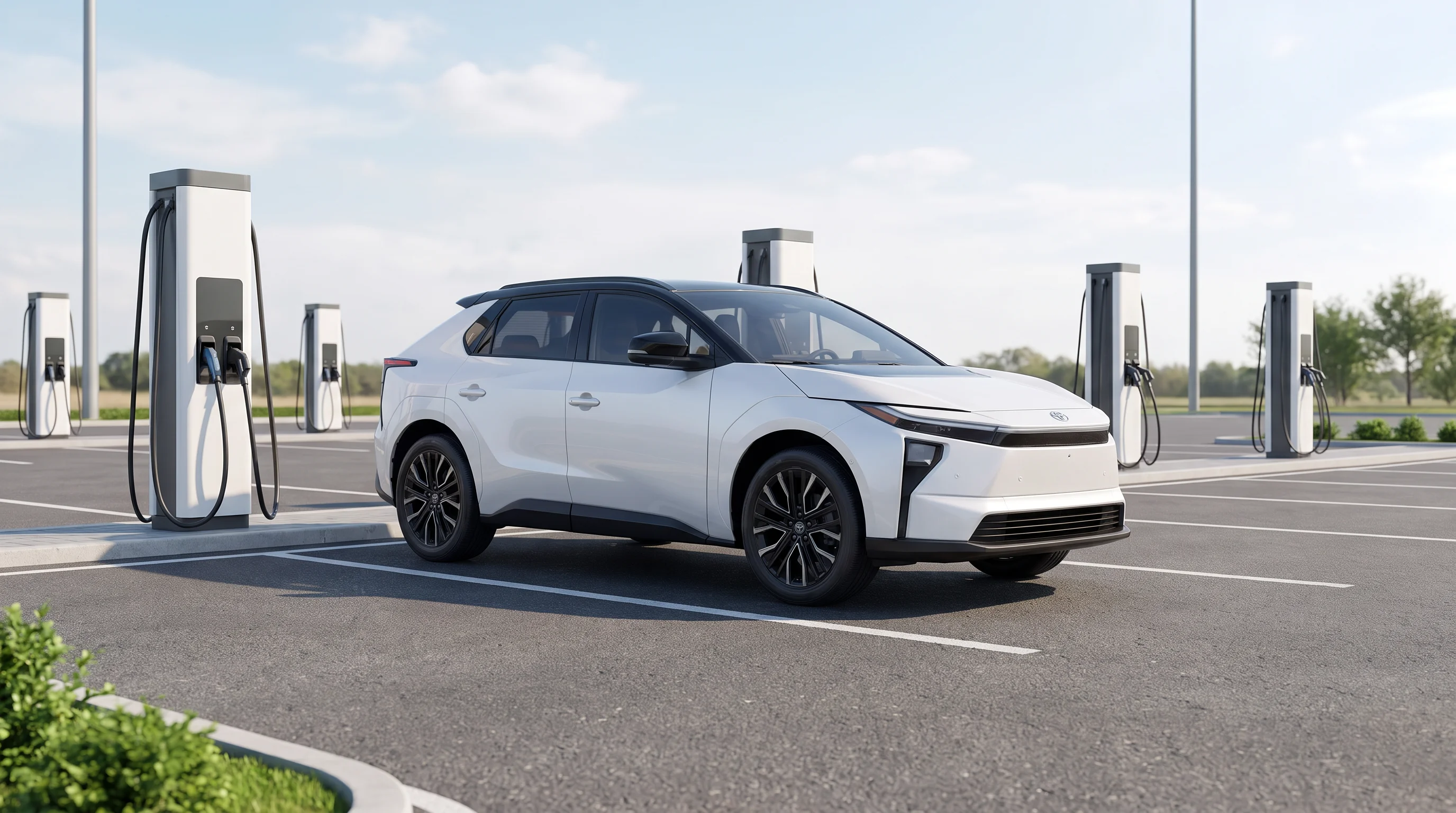
2027 Toyota bZ Electric Range and Battery Capacity by Grade
The 2027 Toyota bZ comes in XLE and Limited grades. Each is offered with front-wheel drive or all-wheel drive, and the lineup uses one of two battery sizes.
Here is the part that trips people up. The smaller battery is tied to one configuration, not to a grade. The entry XLE FWD is the only setup that uses it, which means an XLE with all-wheel drive gets the larger pack.
The entry XLE FWD pairs a 57.7-kWh battery with 165 total system horsepower. Every other setup uses a 74.7-kWh battery. Front-wheel-drive models above the base grade make 221 horsepower. All-wheel-drive models make 338.
| Configuration | Battery | Total System Horsepower | EPA-Estimated Range |
|---|---|---|---|
| XLE FWD | 57.7 kWh | 165 hp | 236 miles |
| XLE FWD Plus | 74.7 kWh | 221 hp | 314 miles |
| XLE AWD | 74.7 kWh | 338 hp | 288 miles |
| Limited FWD | 74.7 kWh | 221 hp | 299 miles |
| Limited AWD | 74.7 kWh | 338 hp | 278 miles |
Real-world range varies from the EPA-estimated ratings with driving style, highway speed, outside temperature, and climate control use. South Orange County has a Mediterranean climate, so cold-weather range loss is rarely a factor here. The battery pack spends most of the year in a comfortable thermal window. Drivers in Mission Viejo and along the I-5 corridor generally see less seasonal variation than drivers in colder regions, though actual range always varies from the EPA-estimated ratings.
EPA-estimated fuel economy figures are for comparison purposes only. Your actual mileage will vary depending on driving conditions, how you drive and maintain your vehicle, battery age/condition, and other factors.
Model-year 2027 specifications, features, and availability are preliminary and subject to change. Figures on this page are sourced from Toyota’s official announcements for the 2027 Toyota bZ and the 2027 Toyota bZ Woodland, and from Toyota’s bZ charging FAQ.
Home Charging the Toyota bZ for Daily Driving
For most South Orange County drivers, home charging covers the whole routine. A Level 2 240-volt setup at home handles daily commuting with no need for public charging.
The 2027 bZ carries an 11-kW onboard AC charger. On a full 11-kW Level 2 source drawing 48 amps, Toyota estimates about seven hours to charge from 10 percent to 100 percent. That fits inside an overnight park.
Level 1 uses a standard 120-volt household outlet. Toyota estimates roughly 60 hours to go from 10 percent to 100 percent at 12 amps. Level 1 is a way to top off, not a daily charging plan.
| Charging Method | Power Source | Estimated Time |
|---|---|---|
| Level 1 | 120V household outlet at 12A | About 60 hours (10% to 100%) |
| Level 2 | 240V, 11 kW at 48A | About 7 hours (10% to 100%) |
| DC Fast Charging | Up to 150 kW | About 30 minutes (10% to 80%) |
Charging times above are Toyota estimates published in the Toyota bZ charging FAQ.
Every bZ includes a portable dual-voltage charging cable. It works with both 120-volt and 240-volt outlets, so basic Level 2 charging does not require buying extra hardware. Using that cable at Level 2 does need a 240-volt NEMA 14-50 outlet. Toyota recommends a licensed electrician for any outlet or charger install. A dedicated wall box on a larger circuit is what unlocks the full 11-kW rate.
Toyota bZ Fast Charging Near San Juan Capistrano
Local fast charging
The most convenient DC fast charging in San Juan Capistrano sits on Del Obispo Street. An EVgo station at Plaza Del Obispo runs eight DC fast-charging stalls, open around the clock. Those stalls use CCS1 connectors, so bring the CCS1 adapter that comes with the vehicle. More fast charging is available along the Interstate 5 corridor. Both EVgo and ChargePoint operate stations across South Orange County. For most local bZ drivers, a fast charge is a short errand rather than a planned trip.
NACS and adapter compatibility
The 2027 Toyota bZ comes with a North American Charging System (NACS) port as standard equipment. That opens direct access to the Tesla Supercharger network, plus most public DC fast chargers in the country. Toyota also includes CCS1 and J1772 adapters with the vehicle. Older station types stay available when a NACS connector is not.
Preconditioning and the Toyota app
Battery preconditioning is standard. It brings the battery pack to its ideal temperature before you reach a fast charger. The car can then accept high power right away instead of ramping up slowly.
Drivers can find stations through the Toyota app. Plug & Charge handles payment on its own at supported networks. Both features need an active Remote Connect trial or subscription, and both depend on a 4G network.
Want to see how the charging port, adapters, and app setup work in person? Our showroom on Camino Capistrano is a good place to walk through it.
Choosing a Charging Setup in South Orange County
For most owners, the answer is overnight Level 2 charging at home. Save public DC fast charging for longer trips. That mix keeps daily energy costs low and leaves flexibility intact when you drive past local city limits.
The bZ lets you set a charging schedule through the vehicle display or the Toyota app. That way you can take advantage of rates that change through the day. For daily driving on the foothill routes near Aliso Viejo, starting each morning with a full battery takes public charging out of the routine.
When you do need a public fast charge, every 2027 bZ accepts up to 150 kW of DC power. Under ideal conditions it moves from 10 percent to 80 percent in about 30 minutes. That applies across the lineup, front-wheel drive and all-wheel drive alike. Charging slows above 80 percent by design, which is why fast-charging stops usually end there.
2027 Toyota bZ Woodland Range and Charging Compared
The 2027 Toyota bZ Woodland is a separate model, not a bZ trim level. For charging, the two are close relatives. The Woodland uses the same 74.7-kWh battery and the same 11-kW onboard AC charger. It has the same NACS port, with CCS1 and J1772 adapters included. Home and public charging work the same way on both.
The differences are drivetrain and range. All-wheel drive is standard on the bZ Woodland, through front and rear eAxles with X-MODE®. Total system output reaches 375 horsepower. Toyota rates the Woodland at a manufacturer-estimated 281 miles on standard all-season tires. The available all-terrain tires drop that manufacturer-estimated rating to 260 miles. That 21-mile gap is worth weighing against how often you actually leave pavement.
Both bZ Woodland grades, the core model and the Premium, share the same powertrain, battery, and charging hardware. The Premium adds comfort and audio equipment. It does not add estimated range or charging capability, so the same charging plan applies to either one.
For South Orange County drivers, the read is simple. If your charging plan works for the bZ, it works for the bZ Woodland. The overnight Level 2 routine is the same. The DC fast-charging behavior is the same. The same Del Obispo fast chargers serve both.
2027 Toyota bZ
- Battery: 57.7 kWh or 74.7 kWh
- Drivetrain: Front-wheel drive or all-wheel drive
- EPA-estimated range: 236 to 314 miles
- Onboard AC charger: 11 kW
- DC fast charging: Up to 150 kW, about 30 minutes from 10% to 80%
2027 Toyota bZ Woodland
- Battery: 74.7 kWh
- Drivetrain: All-wheel drive standard with X-MODE®
- Manufacturer-estimated range: 281 miles, or 260 miles with all-terrain tires
- Onboard AC charger: 11 kW
- DC fast charging: Up to 150 kW, about 30 minutes from 10% to 80%
EPA-estimated fuel economy figures are for comparison purposes only. Your actual mileage will vary depending on driving conditions, how you drive and maintain your vehicle, battery age/condition, and other factors.
Model-year 2027 specifications, features, and availability are preliminary and subject to change. Figures on this page are sourced from Toyota’s official announcements for the 2027 Toyota bZ and the 2027 Toyota bZ Woodland.
Common Questions About Toyota bZ Charging
How fast does DC fast charging work on a Toyota bZ at a public station?
Under ideal conditions, the 2027 Toyota bZ accepts up to 150 kW of DC fast charging power and moves from 10 percent to 80 percent in approximately 30 minutes. This applies to every grade and both drivetrain configurations.
Does warm weather affect the real-world driving range of the Toyota bZ?
Warm weather has a limited effect on battery performance compared with cold weather, though heavy air conditioning use will reduce driving range below the EPA-estimated rating. Pre-cooling the cabin while the vehicle is still plugged in preserves battery energy for the drive itself.
Can the Toyota bZ use Tesla Supercharger stations?
Yes. The 2027 Toyota bZ comes with a North American Charging System port as standard equipment, so it connects to compatible Tesla Superchargers without an adapter. Included CCS1 and J1772 adapters cover other public station types. Charging locations can be found through the Toyota app with an active Remote Connect trial or subscription.
EPA-estimated fuel economy figures are for comparison purposes only. Your actual mileage will vary depending on driving conditions, how you drive and maintain your vehicle, battery age/condition, and other factors.
Experience the 2027 Toyota bZ at Capistrano Valley Toyota
A test drive at Capistrano Valley Toyota is the best way to judge the quiet cabin, the instant torque, and the range tools of the bZ. The 14-inch Toyota Audio Multimedia touchscreen is standard. It is where most charging and range functions live day to day.
Comparing electric options? Browse the wider electrified Toyota lineup. You can also find more model details in our Toyota research hub.
Disclaimers
EPA-estimated fuel economy figures are for comparison purposes only. Your actual mileage will vary depending on driving conditions, how you drive and maintain your vehicle, battery age/condition, and other factors.
Model-year 2027 specifications, features, and availability are preliminary and subject to change. Figures on this page are sourced from Toyota’s official announcements for the 2027 Toyota bZ and the 2027 Toyota bZ Woodland, and from Toyota’s bZ charging FAQ. Charging station details are sourced from EVgo.
0 comment(s) so far on 2027 Toyota bZ and bZ Woodland: Range and Charging Guide for South Orange County