


Where to Charge Your EV or Plug-In Hybrid in South Orange County
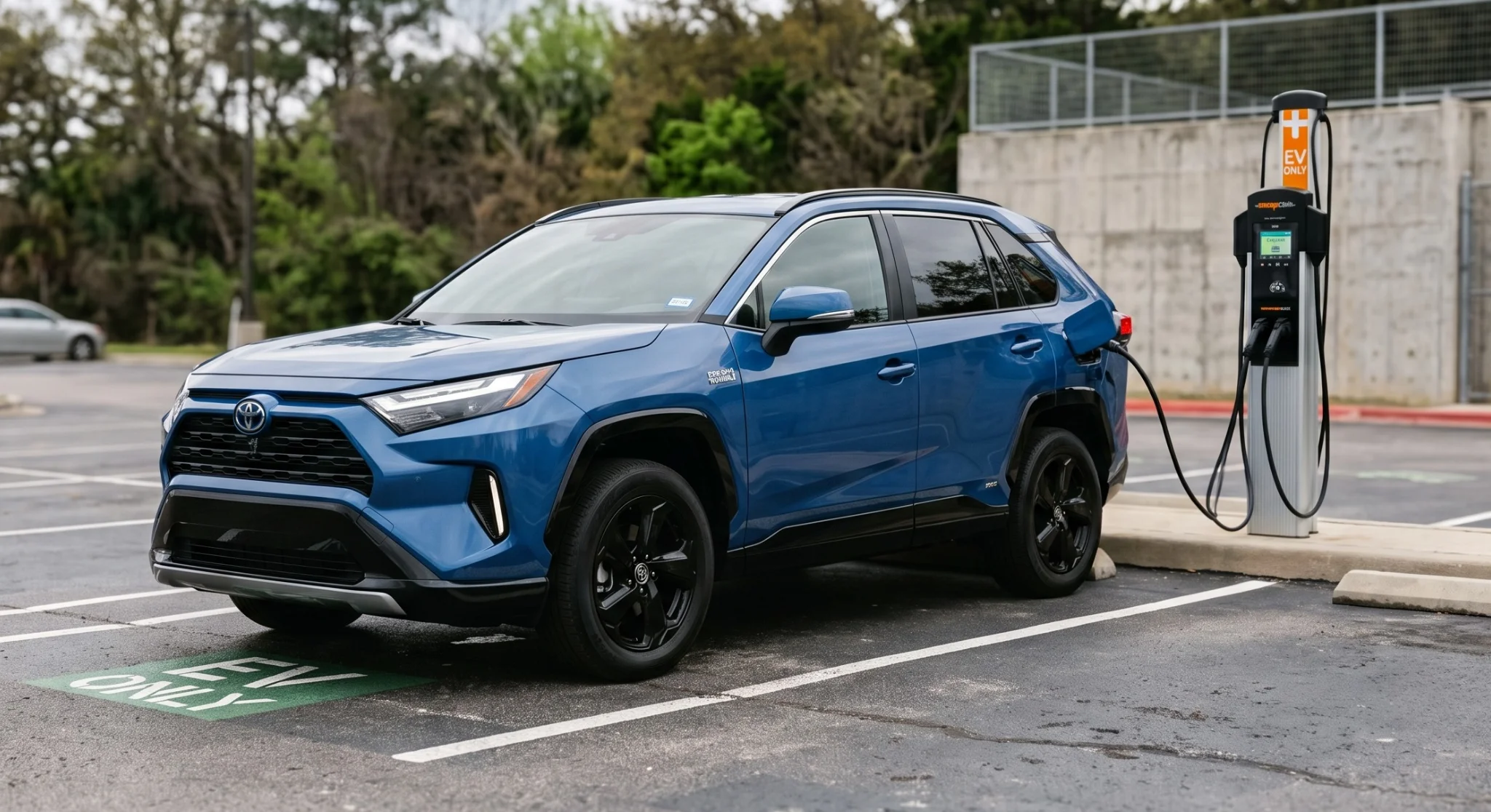
Switching to an electric or plug-in hybrid Toyota changes one daily habit more than any other: how you refuel. Instead of a gas station, you have a range of charging options — at home, around town, and along the highway. Each option has its own speed and best use. This guide walks through how EV charging works, what a home setup costs, how the charging network is changing, and how to keep your battery healthy across South Orange County.
Understanding Level 1, Level 2, and DC Fast Charging
Charging speed depends on the tier you use. The three tiers — Level 1, Level 2, and DC Fast Charging — differ mainly in voltage, hardware, and where you find them, following U.S. Department of Transportation charging classifications.
| Charging Level | Power Source | Est. Range Added Per Hour | Best For |
|---|---|---|---|
| Level 1 | Standard 120V household outlet | 3–5 miles | Plug-in hybrids, short commutes, overnight top-ups |
| Level 2 | 240V circuit (like a clothes dryer) | 20–30 miles | Daily home and public charging (full charge in about 4–10 hours) |
| DC Fast Charging | High-voltage direct current | 100–200 miles in about 30 minutes | Road trips and rapid mid-trip top-ups |
Level 1 is the most basic method. It uses a standard 120-volt household outlet, so it is highly accessible but slow. It works best for plug-in hybrids with smaller batteries, or for drivers with short daily commutes who can leave the vehicle plugged in overnight.
Level 2 steps up the power with a 240-volt circuit — the same kind of service a clothes dryer uses. Most public charging stations and home setups rely on this tier, which makes it the practical backbone of daily electric driving. DC Fast Charging is different again. It bypasses the vehicle’s onboard charger to send high-voltage direct current straight to the battery pack. That is why it is built for long trips rather than everyday use.
Installing a Level 2 Charger at Home and Estimating Your Setup Costs
A Level 2 setup at home is the most convenient way to keep an electric vehicle ready for daily use. Installation usually involves buying a wall-mounted charging unit and hiring a certified electrician to install a dedicated 240-volt circuit. Industry estimates for a typical installation break down like this:
- Charging unit (hardware): $350–$700
- Professional labor, permits, and panel work: $500–$1,300
- Typical all-in cost: $800–$2,000
One of the most common questions shoppers ask is whether they must install a 240-volt outlet before taking delivery. Plug-in hybrids can get by on a standard outlet. Still, a Level 2 home charger is a major convenience upgrade, because it cuts charge times from half a day to just a few hours.
That fast home recovery is especially useful for residents on larger properties in Trabuco Canyon. There, foothill drives and longer distances to the nearest highway corridors make starting each morning with a full battery genuinely practical.
The Transition to NACS and How the New Standard Works With Non-Tesla EVs
The North American charging landscape is shifting toward the North American Charging Standard, or NACS (now formalized as SAE J3400). Historically, most non-Tesla EVs used the SAE J1772 connector for Level 1 and Level 2 AC charging, and the CCS (Combined Charging System) connector for DC fast charging. The NACS design combines both AC and DC charging into a single, compact plug. It is rapidly becoming the universal standard across major manufacturers.
For drivers of non-Tesla EVs, this transition does not make older hardware obsolete. Automakers are providing approved adapters that let vehicles with CCS ports connect to NACS charging stations. That opens up thousands of high-speed public chargers that were previously limited to a single brand, which expands access and eases route planning. If you are ready to move into a more efficient vehicle, you can explore our latest electric and hybrid Toyota lineup online.
Navigating Public Charging Stations: Per-kWh Billing, Idle Fees, and Etiquette
Using public infrastructure means understanding how you are billed and how stations are shared. In California, state regulations require public EV chargers to bill by the kilowatt-hour rather than by the minute. That means you pay for the actual energy delivered to your battery, rather than being penalized when charging slows down due to battery temperature or station congestion.
Beyond the cost of energy, many networks enforce idle fees to keep stations available. If a vehicle stays plugged in after reaching a full charge, networks often charge an idle fee ranging from about $0.40 to $1.00 per minute. These fees encourage drivers to move promptly once charging is complete, so others are not locked out.
Basic etiquette makes public charging smoother for everyone. When you charge while running errands at a suburban retail hub like those in Mission Viejo, monitor your progress on your smartphone app. Return to move your vehicle once it reaches your target level. Never unplug another vehicle without the owner’s consent, and avoid parking in charging spaces if you do not intend to plug in.
Protecting Battery Health and the Effects of Frequent DC Fast Charging
The speed of DC fast charging is convenient for road trips. Still, relying on it as your daily energy source can affect battery longevity over time. Because it pushes high-voltage direct current straight into the cells, it generates heat and electrical stress. Over the long term, that thermal load can slightly accelerate the natural degradation of lithium-ion cells. The result is a modest reduction in maximum EPA-estimated range compared with a battery charged mostly on lower-voltage Level 2 power.
To protect battery health, manufacturers recommend using DC fast charging selectively rather than daily. Save it for long trips or the occasional urgent top-up. For everyday driving, a home or workplace Level 2 charger is much gentler on the battery. Keeping your state of charge between roughly 20% and 80% for daily use also helps preserve capacity for years to come. That is gentler than draining it completely or holding it at 100% for long stretches.
The information in this article is general guidance and does not constitute a specific diagnostic or repair recommendation for any individual vehicle. Repair and maintenance decisions should be made in consultation with a certified technician based on the specific condition of your vehicle.
What Happens When a Plug-In Hybrid’s Battery Runs Out
A common concern about plug-in hybrids is what happens when the battery is fully depleted. The design ensures you are never stranded. When the battery reaches its minimum threshold, the onboard computer automatically switches to the gasoline engine, and the vehicle operates just like a conventional hybrid.
In this mode, regenerative braking captures energy during deceleration and converts it back into electricity to maintain a baseline charge. That charge powers auxiliary systems and assists the engine during acceleration, so you still benefit from hybrid efficiency. You can drive on gasoline alone indefinitely, but doing so misses the point of the vehicle. You would give up the maximum fuel economy and the quiet, EPA-estimated electric-only range that regular charging provides.
How to Locate Charging Stations and Plan Your Route in South Orange County
Finding chargers is easier than ever thanks to in-vehicle navigation and mobile apps. Most current EVs include built-in route planners that track your state of charge, identify compatible stations along your path, and estimate how long you need to stop. Many can even pre-condition the battery as you approach a fast charger, which optimizes charging speed the moment you plug in.
For smartphone users, mapping apps such as Apple Maps and Google Maps offer EV-specific features. You can filter by plug type, view real-time station availability, and see charging speeds by location. On longer trips, a good rule of thumb is to plan charging stops every 100 to 150 miles. Keep a buffer of at least 10% to 20% state of charge to account for traffic, detours, or climbs.
Quick Answers to Common EV Charging Questions
Is it safe to charge an electric vehicle in the rain?
Yes. EV charging systems are built with extensive weatherproofing. The connectors and vehicle inlets are engineered so electricity does not flow until a secure, watertight connection is established. That means you can charge safely at home or at public stations in wet weather.
Do I need a specific brand of Level 2 home charger for my Toyota?
No. You do not need a proprietary brand, as long as the unit has a compatible connector or you use an approved adapter. Most quality chargers use universal standards that work across makes. We recommend a UL-listed unit from a reputable manufacturer, installed by a licensed electrician.
Can I get a federal tax credit for buying an EV or plug-in hybrid today?
No. The federal clean vehicle tax credits were terminated by Public Law 119-21 (enacted July 4, 2025) for all vehicles acquired after September 30, 2025. The only exception is if you took possession of a vehicle acquired on or before September 30, 2025, under a binding written contract with a payment made by that date. We recommend confirming eligibility for any remaining state or local incentives with your tax professional and our team.
Are there California state incentives now that the federal EV tax credit has ended?
Yes. While the federal clean vehicle tax credits ended for vehicles acquired after September 30, 2025, California offers several state-level programs. The centerpiece is MyFirstEV, signed into law in July 2026, which provides an instant point-of-sale rebate rather than a tax credit you claim later — the discount is applied right at the dealership. When the program launches (expected later in summer 2026), eligible buyers can receive $3,500 off a new zero-emission vehicle with an MSRP of $50,000 or less, or $1,750 off a used zero-emission vehicle priced at $25,000 or less. The rebate is open to any Californian buying or leasing their first zero-emission vehicle, with no income cap. The California Air Resources Board is overseeing the program, and funding-access details are expected soon. Note that MyFirstEV applies to fully electric vehicles only, not plug-in hybrids.
What assistance is available for income-qualified buyers in California?
California’s Clean Cars 4 All (CC4A) and Driving Clean Assistance Program (DCAP) help income-qualified residents move into a clean vehicle. Through the scrap-and-replace pathway, eligible buyers in a disadvantaged community who retire an older, high-emitting vehicle can receive up to $12,000 toward a new or used battery electric, plug-in hybrid, or fuel cell vehicle, plus up to $2,000 toward charging. For those without a car to scrap, DCAP’s Financing Assistance pathway offers up to $7,500 toward the vehicle plus up to $2,000 for charging, along with access to fair-financing options. Eligibility is generally based on household income at or below 300% of the federal poverty level, and program funding can be limited, so it is worth checking availability early. Confirm current eligibility and details at DriveClean.ca.gov.
Are there rebates to help cover the cost of a home charger in California?
Often, yes. Many local air districts and electric utilities offer rebates for home and public Level 2 chargers, and the amounts vary by location and, in some cases, household income. Because these programs are administered regionally, availability differs from one service area to the next across South Orange County. The best way to see what applies to you is to search your ZIP code on the state’s DriveClean tool and to check directly with your electric utility. Our team can also help point you toward programs that may apply when you are ready to purchase.
How does extreme heat affect public charging speeds?
Extreme heat can prompt the vehicle’s battery management system to slow charging to prevent overheating and protect battery health. Public DC fast chargers may also reduce output in hot weather to keep their own components cool. For faster speeds on hot days, charge in shaded areas or during cooler morning and evening hours.
What should I do if a public charging station is occupied or broken?
If a station is occupied, use your charging app to find other open plugs nearby or join a digital queue if one exists. If a charger is broken, report it through the network’s app or customer service so a technician can be dispatched. Keeping a backup station in mind while planning your route is always a smart move.
Take the Next Step Toward Electric Driving
Understanding EV charging is the key to a smooth transition to electric driving. Whether you are considering an efficient plug-in hybrid or a fully electric model, the right charging habits and home setup will help you get the most out of your vehicle.
Disclaimers
The information in this article is general guidance and does not constitute a specific diagnostic or repair recommendation for any individual vehicle. Repair and maintenance decisions should be made in consultation with a certified technician based on the specific condition of your vehicle.
EPA-estimated fuel economy figures are for comparison purposes only. Your actual mileage will vary depending on driving conditions, how you drive and maintain your vehicle, battery age/condition, and other factors.
0 comment(s) so far on Where to Charge Your EV or Plug-In Hybrid in South Orange County